Articles in this Volume

Research Article Open Access
Research progress on the role of ellagic acid in improving glucose homeostasis by regulating gut microbiota
Article thumbnail
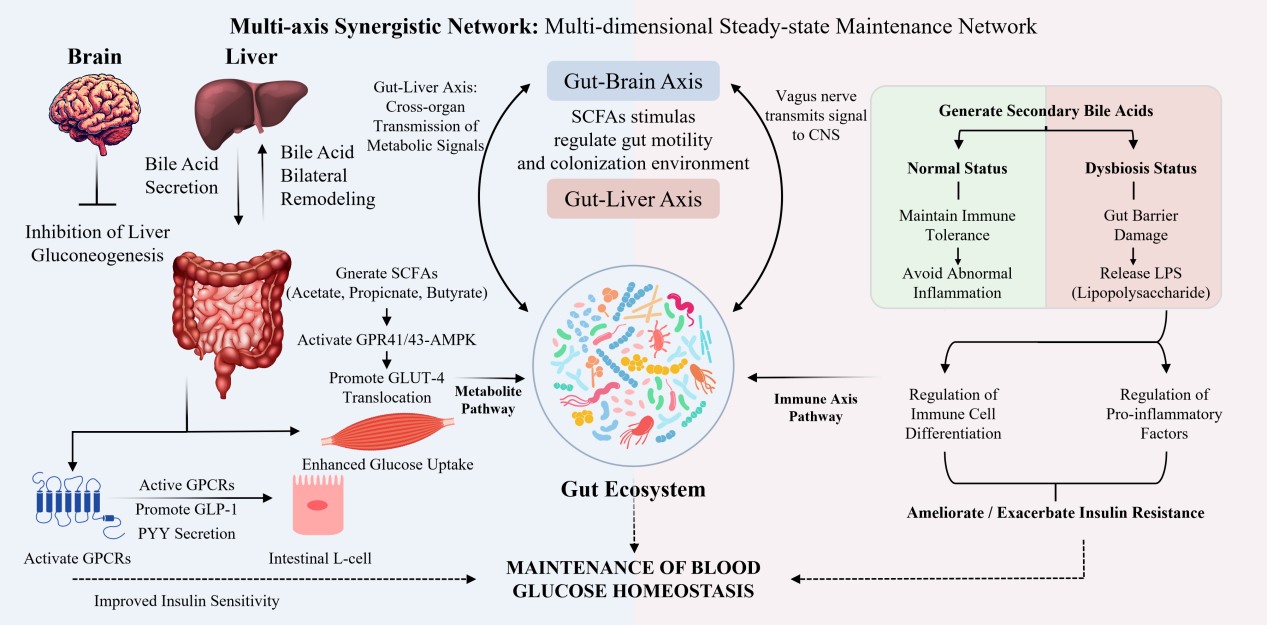
Ellagic acid needs to be metabolized by intestinal flora to urolithin active products, or directly regulates the composition and function of intestinal flora, and maintains blood glucose homeostasis by regulating insulin secretion, improving insulin sensitivity and activating multiple organ regulatory pathways.Animal experiments and clinical studies have confirmed that EA can reduce fasting blood glucose and improve insulin resistance.This article reviews the two-way interaction between EA and gut microbiota, the core pathway of gut microbiota regulating blood glucose, the specific regulatory mechanism of EA and related in vitro and in vivo studies, so as to provide a new perspective for the intervention of glucose metabolism diseases. In the future, it is necessary to focus on the transformation mechanism, dosage form optimization and large sample clinical research to promote its clinical transformation.
Show more
Read Article PDF
Cite
Research Article Open Access
Application and development prospects of bioengineering technology in the big health industry
With the in-depth implementation of theHealthy China2030 blueprint, the big health industry has become an important engine driving economic and social development. As a core supporting force, bioengineering technology is profoundly reshaping the development landscape of the health industry. Based on existing research findings, this paper systematically sorts out the application status of bioengineering technology in core sectors of the big health industry, including the pharmaceutical industry, food industry, precision medicine, marine biological resource development, and biomaterial applications. It also analyzes in detail the challenges encountered in technology application, such as insufficient independent innovation, shortage of capital and talents, and ethical and safety risks. Combined with policy guidance and technology development trends, the paper prospects the future development of bioengineering technology in the construction of the whole industrial chain, multimodal integration, and green intelligent manufacturing. Research shows that the deep integration of bioengineering technology and the big health industry demonstrates huge potential in disease prevention and treatment, health management, and product innovation. However, it is necessary to break through development bottlenecks through multi-dimensional measures such as technological breakthroughs, policy improvement, and talent training, so as to promote the high-quality and sustainable development of the big health industry.
Show more
Read Article PDF
Cite
Research Article Open Access
Development and practice of food bioengineering technology in the context of the big health industry
With the in-depth implementation of the "Healthy China" strategy, the big health industry has become a key driver of national economic growth. As a core domain of modern food science, food bioengineering technology is encountering unprecedented opportunities for advancement within this context. This paper systematically elaborates on the conceptual framework of food bioengineering technology and its strategic positioning in the big health industry. It further provides an in-depth analysis of the research progress and practical applications of key technologies—such as glyco-bioengineering, fermentation engineering, enzyme engineering, and genetic engineering—in areas including functional food development, green food production, and food safety control. The findings indicate that food bioengineering technology supports the development of the big health industry through multiple pathways, including improving the nutritional value of foods, enhancing food safety, developing functional food components, and promoting the green transformation of the food industry. In response to existing challenges—such as immature core technologies, incomplete industry standards, and insufficient integration of industry, academia, and research—this paper proposes several countermeasures, including strengthening fundamental research, improving the standardization system, promoting collaborative innovation, and cultivating interdisciplinary talent. These efforts aim to provide theoretical references for the innovative development of food bioengineering technology in the context of the big health industry.
Show more
Read Article PDF
Cite